
AV Receiver Power Ratings Explained: Why 110 Watts Per Channel Is Not 110 Watts in Your Room
An AV receiver's watts per channel figure is measured with two channels driven, not seven or nine, so it tells you very little about what the amplifier delivers during a loud scene. My position: speaker sensitivity, listening distance and room correction decide your usable headroom far more than the number printed on the carton.

Two AV receivers sit side by side. One is rated 110 watts per channel, the other 95. The 110 is the louder one, obviously.
Usually not by any amount you would notice. That watts per channel figure is measured with two channels driven, into 8 ohms, across a stated bandwidth and at a stated distortion limit. A seven or nine speaker system playing a loud scene is not doing that. My position, before any of the engineering: in most Indian living rooms, speaker sensitivity, listening distance and placement decide how loud and how clean your system gets, far more than the difference between 95 and 110 on a brochure.
This matters because power is the number buyers argue about most and understand least.
What the watts per channel number is actually measuring
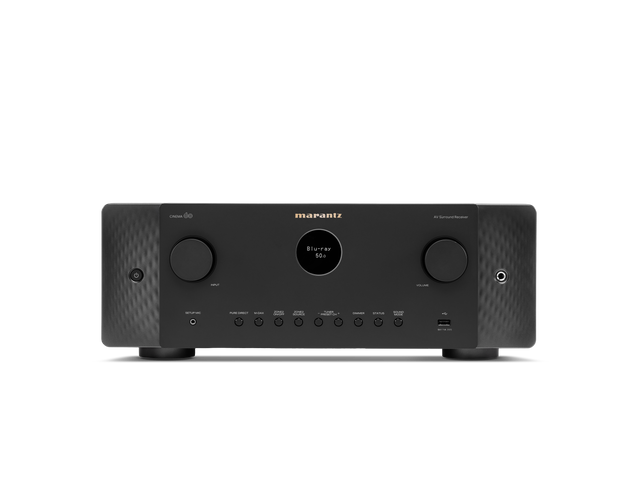
Take a current example. On its official product page, Marantz publishes the CINEMA 50 SERIES 2 as 110 watts into 8 ohms, 20 Hz to 20 kHz, at 0.08 percent distortion, two channels driven. The same page also publishes 150 watts into 6 ohms, at 1 kHz, at 0.7 percent distortion, two channels driven.
Same amplifier. Two numbers, 40 watts apart. Nothing was upgraded between them. Only the measurement conditions changed: a single frequency instead of the full band, a lower impedance, and roughly nine times the allowed distortion.
Neither number is dishonest. Both are manufacturer specifications measured to a stated method, and Marantz states the method, which is more than many brands do. But a specification is evidence, not a conclusion. If two receivers quote power under different conditions, comparing the headline figures tells you almost nothing.
Two channels driven is a laboratory condition. Your Tuesday night action film is not a laboratory.

Why the third, fourth and fifth channel change the picture
An AV receiver has one power supply feeding every amplifier channel. When two channels draw hard, the supply copes comfortably. When seven or nine channels draw hard at the same time, which is exactly what happens in a dense surround mix, the available power per channel falls.
How far it falls depends on transformer size, capacitor reserve and thermal design. Very few manufacturers publish an all channels driven figure, and the ones that do usually publish a considerably smaller number. That is not a scandal. It is physics, and it applies to every receiver at every price.
The practical consequence: an AVR rated at 110 watts is not delivering 110 watts to nine channels simultaneously. It does not need to. Surround and height channels rarely demand full output at the same instant as the front three. But it does mean the rated figure is a ceiling under favourable conditions, not a budget you can spend nine times over.
Decibels are not linear, and this is where the argument usually collapses
Doubling amplifier power buys you about 3 dB of extra output. Not double the loudness. About 3 dB, which most listeners describe as clearly audible but modest.
So what does going from 95 watts to 110 watts buy? Around 0.6 dB. You could lose more than that by sitting slightly differently on the sofa.
Now look at the speaker side. A speaker rated 3 dB more sensitive gives you the same 3 dB as doubling your amplifier power, for free, at every volume setting. A speaker 6 dB more sensitive is worth roughly four times the amplifier power. Speaker sensitivity is the least glamorous number on any spec sheet and quietly the most useful one.
If you want more usable output, the cheapest decibels almost always come from the speakers, not the receiver.
Impedance and current, the specs that deserve more attention than watts
Nominal impedance is a nominal figure. A speaker described as 8 ohms may dip to 4 ohms or below at certain frequencies, often in the bass and lower midrange where most of the energy lives. What the amplifier has to supply there is current, not headline watts.
This is where AVRs differ from each other in ways the power rating hides. Two receivers with similar quoted watts can behave very differently into a demanding load: one holds composure, the other starts limiting, runs hot, or in an extreme case drops into protection.
The receiver will not explode. It will start compressing, and the film will quietly start sounding smaller than it should, which is the more annoying outcome because nothing obviously breaks.
If you are running large floorstanders with a difficult impedance curve, the answer is rarely a receiver with 15 more watts on the box. It is preamp outputs and an external power amplifier. Which is worth checking before you buy: does the receiver have full channel pre outs at all?

What actually limits loudness in an Indian living room
Distance costs you output. Every doubling of listening distance costs several dB, and in a typical Indian living room the main seating is often 3.5 to 4.5 metres from the front speakers, sometimes further in an open plan hall that runs into the dining area. That distance is doing more damage to your headroom than the receiver is.
Then there is the room itself. Marble and vitrified tile floors, glass windows and cupboard fronts, and very little soft furnishing. Hard surfaces do not reduce measured level. They do the opposite: they add reflections, which raises the measured sound pressure while reducing clarity and making dialogue harder to follow. So the system measures loud and sounds unclear, and the owner concludes it needs more power.
A marble floor does not care what the box says.
Open plan matters too. A hall that opens into a passage or a dining space loses bass reinforcement compared with a closed room of the same footprint. Same speakers, same receiver, noticeably less impact.
When more amplifier power is the right answer
I am not arguing that power never matters. It does, in specific cases:
- Low sensitivity speakers, in the 84 to 86 dB range, which are common in some hi fi oriented designs.
- Large or open plan rooms with long listening distances.
- Owners who actually watch at or near reference level rather than 15 to 20 dB below it.
- Systems where the front three channels are asked to carry a lot without a subwoofer doing its share.
In those cases the fix is usually an external power amplifier driving the front channels through the receiver's pre outs, with the AVR handling processing and the remaining channels. That buys you real headroom. Trading one receiver for another with a slightly larger number on the carton does not.
The counterargument worth taking seriously
"My system sounds thin and strained when I turn it up, so it must need more watts."
That is a common way of reading the symptom, and sometimes it is correct. More often, in the systems we see, the cause is elsewhere: speakers set to Large so the receiver sends deep bass to speakers that cannot reproduce it, a crossover set by habit rather than by measurement, a subwoofer level set by ear on the wrong track, or a room mode putting a large peak and a large null within a metre of each other.
All of those produce exactly the sensation of running out of steam. None of them are solved by watts.
This is what room calibration is for, and why I would measure before I would spend. Auto calibration built into the receiver is a reasonable starting point and gets most of the channel levels and distances close. It cannot change the laws of acoustics because the setup menu asked nicely, and it does not replace a proper measured setup with attention to crossover choice, subwoofer placement and bass management.

What I would do before spending anything
- Write down your speakers' sensitivity and your seating distance. Those two numbers explain most of your loudness situation.
- Check whether your speakers are set to Small with a sensible crossover, and whether your subwoofer is actually carrying the low end.
- Run the receiver's auto calibration properly, with the microphone at ear height at the main seat, and the room quiet.
- Listen again at your normal volume. If it now sounds clean and only slightly short on ultimate level, you do not have a power problem.
- If it still strains, look at speaker sensitivity or an external amplifier on the front channels before you look at a different receiver.
The buying implication
If you are choosing between two AV receivers and the only meaningful difference is 10 or 15 watts on paper, choose on the things that will actually affect you over five years: number of processing channels, pre out availability, room correction options, HDMI capability for the sources you own, and whether the unit comes with official India warranty support through an authorised channel.
And if the correct answer for your room is that you do not need to change anything yet, that is a perfectly good answer. Keeping what you own and calibrating it properly is often the larger improvement.
If you want a second opinion on your room
We offer a free room consultation. Share your room dimensions, seating position, current speakers and receiver, and what you mostly watch or listen to, and we will tell you where your system is actually limited. If the answer is "nothing to buy, fix the setup", we will say that.
For Denon and Marantz AV receivers and processors, we also offer professional room calibration as a paid service, in three levels depending on how far you want to take the measurement and correction work. It is the step most owners skip and the one that changes the most.
Specifications quoted above are from the official Marantz CINEMA 50 SERIES 2 product page and are manufacturer figures. Independent measurement of any receiver's all channels driven behaviour is a separate question, and I would rather measure it than assume it.
More from Learn
-
7.2 AVR
The 5 Best 7.2 AV Receivers You Can Actually Trust in India (2026)
Five 7.2 receivers we actually stock, ranked by price and judged on the spec that decides whether you...
-
5.1 Home Theater
Best 5.1 Home Theater Setups Under ₹1.5 Lakh in India (2026 Guide)
A budget of ₹1 to 1.5 lakh buys a properly satisfying 5.1 in India in 2026 if you...
-
Buyer Guide
Do Passive Speakers Ever Need a Service Centre? What the Warranty Small Print Actually Tells You
Passive speakers are the least likely part of a home cinema to need service, and two manufacturers say...
Got a question this didn't answer?
Ask us about your own room.
Guides cover the general case. If you want an answer for your room, your budget and your gear, ask — we answer real questions publicly.
Ask AV Kart